Longitudinal study of Iranian aging - Persian Aging
Iranian Longitudinal Study on Aging
IRILSA-Persian E
The main study site
Neishabour (NeLSA)
Place of study
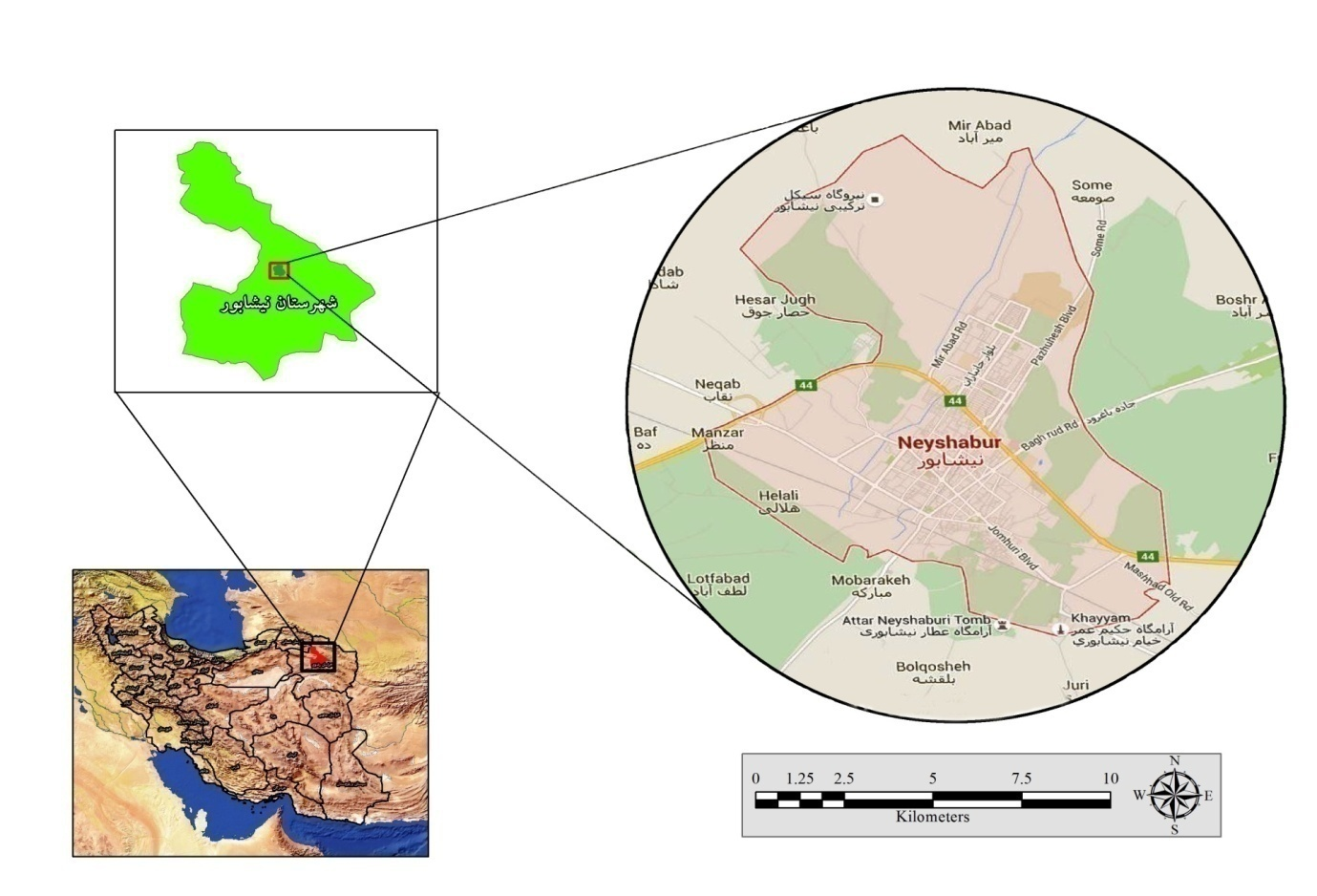
At present, the first starting point of the Persian aging cohort of Neishabour city, located approximately 120 km from Mashhad, the capital of Khorasan Razavi province - northeastern Iran, and the study center has been fully equipped for this purpose. Other places in other provinces of the country will join the aging Persian cohort in the future.
Figure 1- Geographical location of Neishabour city located in Khorasan Razavi
An overview of the history of Neishabour:
Neishabour is a city in Khorasan Razavi province, and the second largest city in Khorasan provinces after Mashhad. Located in the foothills of Binalood in northeastern Iran, it is one of the most important historical, tourism and industrial centers for the country and the region and is mentioned as a symbol of Iranian history and culture.
Neishabour city based on the general census of 2016, 264 ٬ 375 people; Its central section, 319,576 people; And the whole city has a population of 451,780. The historical position of Neishabour in Khorasan has been replaced by Mashhad from the Safavid period in a step-by-step process. The all-round prosperity and development of Neishabour and its region (Neishabour quarter) is the period of the Middle Ages to the reign of the Khwarezmshahis and during this period, it is considered as a cultural capital for Iran. In the 11th century AD, with a population of 125,000, it was the eighth largest city in the world (a metaphor for the well-known civilizations of the time). The history of Neishabour dates back to the Sassanid period and was the center of the metropolis of Abarshahr; It was founded or rebuilt around the middle decades of the third century AD by order of Shapur I. It was conquered in 643 AD with the peace treaty of Kenarng and Abdullah Amer. From 821 AD to 873 AD, it was the capital of the Taherian emirate, then the capital of the first Seljuk satellite was chosen by Tughral
The scientific field of this city in the golden age of Islam was considered as one of the greatest centers and homeland of many scientists, poets, Sufis and other greats and it is considered as one of the greatest centers of Islamic civilization and culture, especially in the Seljuk era. During this period, it hosted immigrants from most of the provinces of the Abbasid caliphate, a process that was widespread and continuous until the overthrow of the Khwarezmshah dynasty.
What remains of ancient Neishabour is an area called Kohandaj in the south of the present city. The first archaeological excavations were carried out in 1935 and 1947 by the Metropolitan Museum of Art in New York and have been carried out continuously and intermittently. According to more recent research, in the third millennium BC, this region had trade relations with the Indus Valley and Mesopotamia; Therefore, the history of urbanization in Neishabour region dates back to before the Sassanid period and the third century AD and it is considered the oldest ancient region in Greater Khorasan that is still inhabitable.
The distance of this city from road 44 to Mashhad is 124 km. M., up to Tehran 768 k. yogurt. Bajgiran is the closest border crossing and Ashgabat with a distance of about 190 km is the closest capital of a country to it. He joined the national railway of Iran on July 23, 1956. The economy of Neishabour city is based on agriculture-animal husbandry, trade and some handicrafts and factories. The karez (local: aqueduct) is the most important source of ancient water, which is more or less important today.
The two days of April 15 and May 18 in the official Iranian calendar are named after two world leaders from Neishabour, Farid al-Din Attar and Omar Khayyam. Neishabour special media includes several news websites and Neishabour and Khayyamnameh morning newspapers.
The arts of pottery, carpet weaving and carpentry have an ancient prominence in Neishabour. Artifacts from ancient Neishabour, most of which are pottery, are kept in museums such as the Tehran Pottery Museum, the New York Metropolitan Museum of Art, and the Los Angeles County Museum of Art, and some of them are scattered throughout various museums in Iran and around the world.
Neishabour city has the climatic characteristics of the central plateau of Iran (its plains have a mild semi-desert climate); It is relatively cold in winters and mild in summers. With an average above 13.9 °, below 7.1 ° and a maximum of 22.5 °, it is considered as one of the cold regions of the province. January is the coldest and warmest month in Neishabour.